


-
- Books & Magazines
- Login
- Language: Eng हिंदी
Home / Bharatiya Sakshya Adhiniyam & Indian Evidence Act
Criminal Law
Presumptions
« »13-Dec-2023
Introduction
Black's Law Dictionary defines presumption as a legal inference, or assumption that a fact exits, based on the known or proven existence or some other fact or group of facts.
- In the Law of Evidence, presumption is not evidence in itself but an inference of the existence or non-existence of a fact.
Types of Presumptions
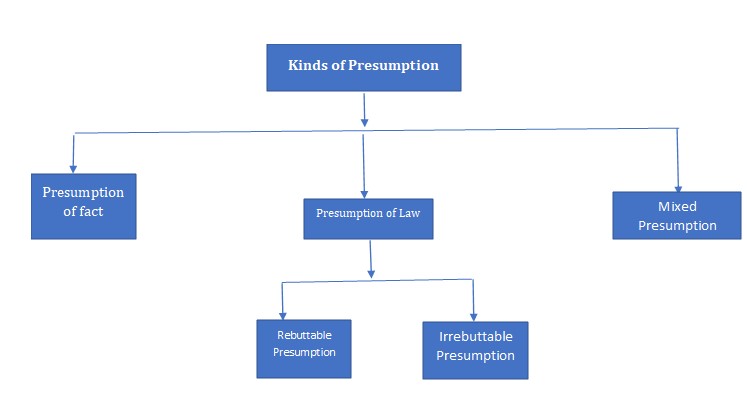
Presumptions are of three kinds:
- Presumption of fact or natural presumption
- Presumption of law
- Mixed Presumption
Presumption of Fact
- Presumption of fact are inferences which are naturally drawn from observation of the course of nature and the constitution of human mind.
- These presumptions are generally rebuttable.
Presumption of Law
- The presumption of law is of two kinds:
- Irrebuttable Presumption: The conclusive or irrebuttable presumptions of law are those legal rules which are not dominated by any evidence that the fact is otherwise.
- Rebuttable Presumption: This kind of presumption arises when presumptions of law are certain legal rules, defining the amount of evidence requisite to support a particular allegation, which facts being proved may be either explained away or rebutted by evidence to the contrary, but are conclusive in absence of such evidence.
Mixed Presumptions
- Mixed Presumptions of law and fact are chiefly confined to the English law and so it is not necessary to presume subject here.
May Presume, Shall Presume and Conclusive Proof
- Section 4 of Indian Evidence Act, 1872 (IEA) defines May Presume, Shall Presume and Conclusive Proof.
- May presume
- Whenever it is provided by this Act that the Court may presume a fact, it may either regard such fact as proved, unless and until it is disproved, or may call for proof of it.
- Whenever the expression “may presume” has been used in the Act, a discretion has been given to the Court to presume a fact or refuse to raise such a presumption.
- Example: Section 90 of IEA provides that when a document purporting to be thirty years old is produced from a proper custody, the court may presume that the document was signed and written by the person by whom it purported and is said to have been written and signed.
- Shall Presume:
- Whenever it is directed by this Act that the Court shall presume a fact, it shall regard such fact as proved, unless and until it is disproved.
- Where the expression “shall presume” has been used, then the Court shall presume in that event and no discretion has been left with the Court as there is legislative command to it to raise a presumption and regard such fact as proved unless and until it is disproved.
- Conclusive Proof
- When one fact is declared by this Act to be conclusive proof of another, the Court shall, on proof of the one fact, regard the other as proved, and shall not allow evidence to be given for the purpose of disproving it.
- It is well settled that where an Act enjoins any evidence to be treated as conclusive proof of certain factual situation or legal hypothesis, no other evidence may be adduced to contradict or vary the aforesaid conclusiveness.
Difference Between Presumption of Fact & Presumption of Law
| Presumption of Fact | Presumption of Law |
|
|
|
|
|
|
|
|
|
|
|
|