


-
- Books & Magazines
- Login
- Language: Eng हिंदी
Supreme Court Reduces 3-Year Practice Rule to 1 Year for Judiciary Exams
« »24-Aug-2026 | Drishti The Vision
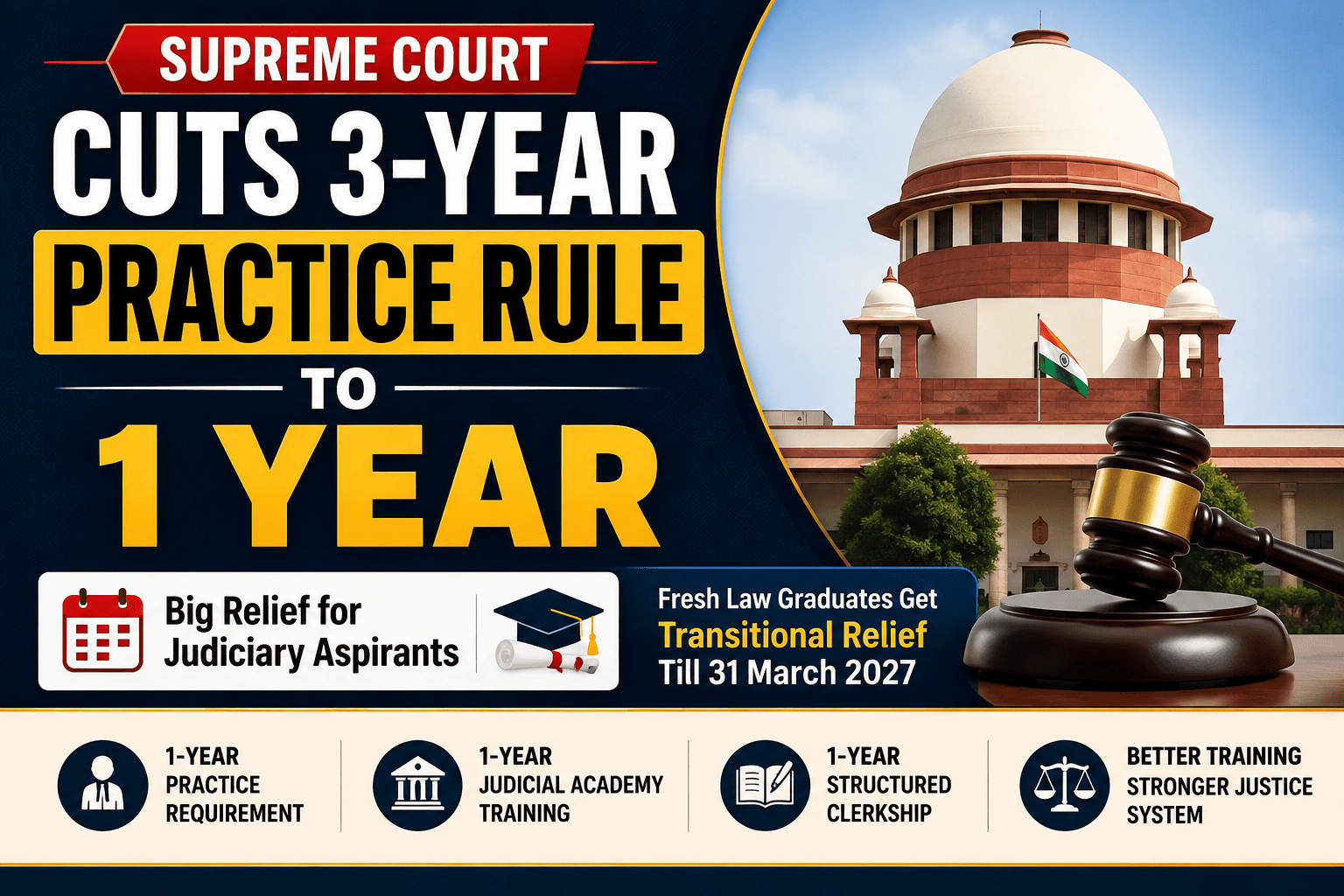
The Supreme Court has provided major relief to judiciary aspirants by modifying its earlier three-year legal practice requirement for appointment as Civil Judges (Junior Division).
In Bhumika Trust v. Union of India and connected cases (2026), the Court retained the need for practical legal exposure but reduced the pre-entry practice requirement to one year. More importantly, it introduced a transitional relaxation for recruitment notifications issued up to 31 March 2027.
For fresh law graduates preparing for judiciary examinations, this significantly expands the opportunity to enter judicial service.
What Was the 3-Year Practice Rule?
- In May 2025, the Supreme Court restored the requirement of three years of legal practice before a candidate could apply for appointment as a Civil Judge (Junior Division).
- The Court reasoned that judicial officers should have practical exposure to court proceedings, procedural law, advocates and litigants before assuming judicial responsibilities.
- However, concerns were subsequently raised that a compulsory three-year waiting period could create hardship for young graduates and discourage talented candidates from entering judicial service.
What Has the Supreme Court Changed?
The Supreme Court has now modified the framework.
|
Particulars |
New Position |
|
Earlier Practice Requirement |
3 Years |
|
Revised Requirement |
1 Year |
|
Transitional Period |
Up to 31 March 2027 |
|
Training After Selection |
1 Year |
|
Structured Clerkship |
1 Year |
|
Regular Appointment |
After satisfactory completion |
The Court has therefore shifted towards a combination of practice + institutional training + practical clerkship instead of requiring the entire period to be completed at the Bar before recruitment.
Who Can Apply Till 31 March 2027?
- This is the most important part of the judgment for present judiciary aspirants.
- For recruitment advertisements falling within the transitional period ending 31 March 2027, law graduates can receive the benefit of the relaxation despite not having completed the earlier three-year practice requirement.
- Such candidates will be deemed to have completed one year of active practice for the purpose of the transitional scheme.
- This gives fresh graduates another opportunity to compete for Civil Judge examinations notified during this period.
What Happens After Selection?
- Candidates selected under the new system will not immediately begin regular service as Civil Judges.
- They will first be appointed as Trainee Judicial Officers and undergo:
- Selection → 1-Year State Judicial Academy Training → 1-Year Structured Clerkship → Evaluation → Regular Appointment
- The clerkship will include practical exposure at both the District Judiciary and High Court level.
- This ensures that candidates acquire practical judicial experience before exercising independent judicial functions.
What Changes From 1 April 2027?
- For recruitment notifications issued from 1 April 2027, candidates will ordinarily require at least one year of actual legal practice.
- Such practice will have to be established through the prescribed Certificate of Practice mechanism.
- Therefore, aspirants should remember the distinction:
- Till 31 March 2027 → Transitional relaxation for law graduates
- From 1 April 2027 → Minimum one-year actual practice requirement
Conclusion
The Supreme Court's decision substantially changes the route to becoming a Civil Judge. Instead of requiring three years at the Bar before entering judicial service, the new framework combines one-year practice, Judicial Academy training and structured clerkship.
For fresh law graduates, the period up to 31 March 2027 is particularly important. Candidates should closely monitor upcoming State Judicial Service notifications and continue their preparation rather than assuming that lack of three years' practice makes them ineligible.
Blog Collection
Law Entrance Preparation
Judiciary Preparation
CLAT Preparation
Civil & Family Law
Criminal Justice System
Environmental and Sustainability Law
Data Privacy and Cybersecurity
Alternative Dispute Resolution
Legal Precedents
Acts and Bills
Bankruptcy and Restructuring
Corporate Governance
Constitutional Law and Public Policy
Contemporary Legal Developments
Law & Society
RECENT POSTS
MP ADPO Exam Date 2026: Exam Rescheduled to 1 November 2026
Delhi (APP) Recruitment 2026
Upcoming Judiciary Vacancies 2026-27: Which State Judiciary Exams Can Students Expect?
Supreme Court Reduces 3-Year Practice Rule to 1 Year for Judiciary Exams
AILET Notification 2027
Haryana ADA Screening Test Result 2026 Declared
Consortium Announces CLAT 2027 Exam Date and Application Schedule
Consortium's Decision on CLAT Expert Committee Report 2026 — No Changes in CLAT 2027
Haryana ADA Admit Card 2026 Released
RPSC APO Mains Examination 2026: Syllabus and Exam Pattern
POPULAR POSTS
MP ADPO Exam Date 2026: Exam Rescheduled to 1 November 2026
Delhi (APP) Recruitment 2026
Upcoming Judiciary Vacancies 2026-27: Which State Judiciary Exams Can Students Expect?
Supreme Court Reduces 3-Year Practice Rule to 1 Year for Judiciary Exams
AILET Notification 2027
Haryana ADA Screening Test Result 2026 Declared
Consortium Announces CLAT 2027 Exam Date and Application Schedule
Consortium's Decision on CLAT Expert Committee Report 2026 — No Changes in CLAT 2027
Haryana ADA Admit Card 2026 Released
RPSC APO Mains Examination 2026: Syllabus and Exam Pattern