


Home / Bharatiya Nagarik Suraksha Sanhita & Code of Criminal Procedure
Criminal Law
Procedural Irregularities
« »03-Oct-2023
Introduction
- A legal proceeding means any proceedings authorized by law for redressal of a legal grievance for violation of a legal right.
- Generally, “irregular” means not conforming to a law or regulation imposed.
- In B.N. Nagarajan v. State of Karnataka (1979), the SC observed that “Irregularities mean acts comprising such defects which are attributable to methodology followed during recruitment while illegality includes violation of law in toto”.
- Irregularities under the Criminal Procedure Code,1973 (CrPC) may be:
- Curable Irregularities - Those which do not vitiate the proceedings.
- Incurable Irregularities - Those which do vitiate the proceedings.
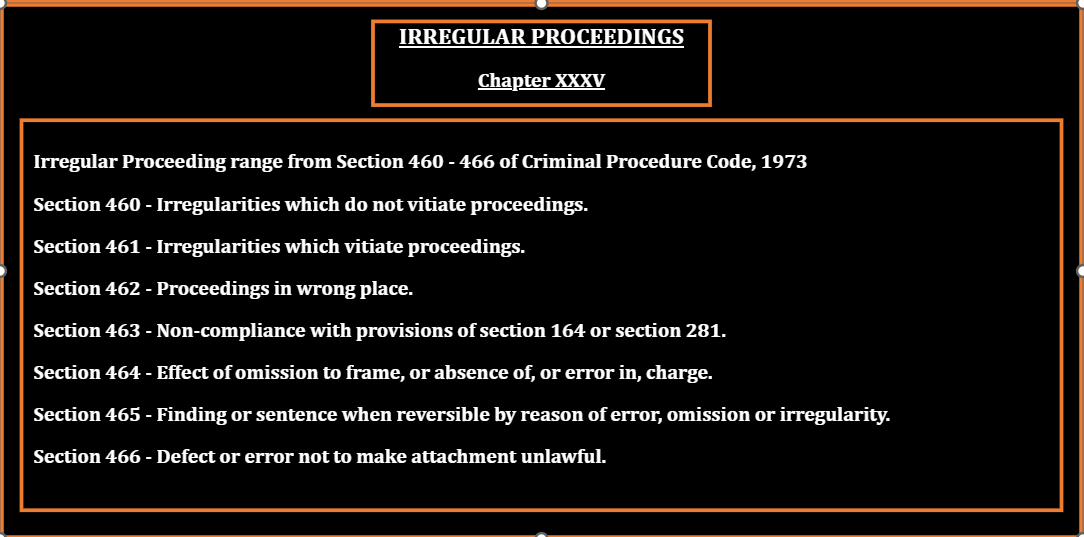
- The provisions related to irregular proceedings are contained in Chapter XXXV of CrPC containing Sections 460 - 466.
Provisions under the Criminal Procedure Code,1973
- The purpose of criminal law is to establish a framework of rules and regulations within a society to define and prohibit behaviour that is considered harmful, dangerous, or disruptive to the well-being of individuals and the community as a whole.
- There may be situations where certain irregularities may take place while the enforcement agencies work on curtailing such activities. Irregularities under Criminal Law are provided by the CrPC as follows:
- Section 460 - Irregularities which do not Vitiate Proceedings
- Section 460 CrPC refers to curable irregularities. They are caused erroneously and in good faith. These irregularities do not cause a failure of justice.
- If a magistrate who is not empowered by law in this behalf does any of the following things, the proceedings shall not be set aside merely on the ground of his not being so empowered:
- To issue a search-warrant under section 94;
- To order, under Section 155, the police to investigate an offence;
- To hold an inquest under section 176;
- To issue process under section 187, for the apprehension of a person within his local jurisdiction who has committed an offence outside the limits of such jurisdiction;
- To take cognizance of an offence under clause (a) or clause (b) of sub-section (1) of section 190;
- To make over a case under sub-section (2) of section 192;
- To tender a pardon under Section 306;
- To recall a case and try it himself under section 410;
- To sell property under section 458 or section 459.
- Case Law:
- P.C. Mishra v. State (C.B.I) & Anr (2014): In this case the Delhi High Court (HC) has held that where a magistrate not empowered by law tenders pardon in good faith then such an order is protected under Section 460 of CrPC.
- Section 461 - Irregularities which Vitiate Proceedings
- Section 461 CrPC lists irregularities, which if committed by any Magistrate, would result in vitiating the proceedings. No question of good faith arises here.
- Legally, such proceedings have no existence.
- If the magistrate not having the power to do any of the following things, does those things, the proceedings shall be void:
- Attaches and sells property under section 83;
- Issues a search- warrant for a document, parcel, or other thing in the custody of a postal or telegraph authority;
- Demands security to keep the peace;
- Demands security for good behaviour;
- Discharges a person lawfully bound to be of good behaviour;
- Cancels a bond to keep the peace;
- Makes an order for maintenance;
- Makes an order under section 133 as to a local nuisance;
- Prohibits, under section 143, the repetition or continuance of a public nuisance;
- Makes an order under Part C or Part D of Chapter X;
- Takes cognizance of an offence under clause (c) of sub- section (1) of section 190;
- Tries an offender;
- Tries an offender summarily;
- Passes a sentence, under section 325, on proceedings recorded by another Magistrate;
- Decides an appeal;
- Calls, under section 397, for proceedings;
- Revises an order passed under section 446.
- Section 461 CrPC lists irregularities, which if committed by any Magistrate, would result in vitiating the proceedings. No question of good faith arises here.
- Case Law
- Govind Ram v. State of Rajasthan (1997): Rajasthan HC has held that where the magistrate lacks initial jurisdiction but still tries the offender, the question of good faith does not arise in this case. Such a proceeding will be vitiated under Section 461.
- Atma Ram v. State of Rajasthan (2019): Supreme Court (SC) has summarized the legal provisions relating to irregular proceedings as:
- ‘Chapter XXXV of CrPC deals with “Irregular Proceedings,” and Section 461 stipulates certain infringements or irregularities which vitiate proceedings. Barring those mentioned in Section 461, the thrust of the Chapter is that any infringement or irregularity would not vitiate the proceedings unless, as a result of such infringement or irregularity, great prejudice had occasioned to the accused.’
- The courts’ prime duty is to evade such circumstances through which the miscarriage of justice is caused.
- The power given in Chapter XXXV should be used properly and with caution.
- Kaushik Chatterjee v. State of Haryana (2020):
- The SC held that any proceeding that is void under Section 461 of CrPC cannot be saved under Section 462.
- However, Section 461 (1) of CrPC renders a Magistrate's proceedings void if he tried a criminal while he was not authorized by law to do so.
- Section 462 - Proceedings in Wrong Place
- No finding, sentence or order of any Criminal Court shall be set aside merely on the ground that the inquiry, trial, or other proceedings in the course of which it was arrived at or passed, took place in a wrong sessions division, district, sub-division, or other local area, unless it appears that such error has in fact occasioned a failure of justice.
- Section 463 - Non-compliance with Provisions of Section 164 or Section 281
- If a court is presented with a confession or statement made by an accused person, which was recorded under section 164 or section 281 but doesn't follow all the required procedures, the court can still consider it as evidence.
- However, this decision is subject to certain conditions - the court can investigate whether the rules specified in those sections were followed by the Magistrate who recorded the statement.
- If the court finds that the non-compliance with these rules did not harm the accused's defence and that the statement was genuinely made, it may admit the statement as evidence.
- This is allowed despite the rules outlined in Section 91 of the Indian Evidence Act, 1872.
- The provisions of this section applies to Courts of appeal, reference, and revision.
- Section 464 - Effect of Omission to Frame, or Absence of, or Error in, Charge
- No finding, sentence or order by a Court of competent jurisdiction shall be deemed invalid merely on the ground that no charge was framed or any error, omission or irregularity in the charge including any misjoinder of charges, unless, in the Court of appeal's opinion, confirmation or revision, a failure of justice has been occasioned.
- If the Court of appeal, confirmation, or revision, is of opinion that a failure of justice has in fact been occasioned, it may, —
- In the case of an omission to frame a charge, order that a charge be framed, and that the trial be recommended from the point immediately after the framing of the charge.
- In the case of an error, omission or irregularity in the charge, direct a new trial to be had upon a charge framed in whatever manner it thinks fit.
- If the Court believes the case's facts are such that no valid charge could be preferred against the accused in respect of the facts proved, it shall quash the conviction or may direct a new trial.
- Section 465 - Finding or Sentence when Reversible by Reason of Error, Omission or Irregularity.
- Subject to the provisions hereinbefore contained:
- No finding, sentence or order passed by a Court of competent jurisdiction.
- Shall be reversed or altered by a Court of appeal, confirmation of revision.
- On account of any error, omission or irregularity.
- In the complaint, summons, warrant, proclamation, order, judgment or other proceedings before or during trial or in any inquiry or other proceedings under this Code.
- In any sanction for the prosecution.
- Unless in the opinion of that Court, a failure of justice has in fact been occasioned thereby.
- In determining whether any error, omission or irregularity has caused a failure of justice, the Court shall consider whether the objection could and should have been raised at an earlier stage in the proceedings.
- Subject to the provisions hereinbefore contained:
- Section 466 - Defect or Error not to Make Attachment Unlawful
- No attachment made under this Code shall be deemed unlawful, nor shall any person making the same be deemed a trespasser, on account of any defect or want of form in the summons, conviction, writ of attachment or other proceedings relating thereto.
Conclusion
Since courts are staffed by humans, one cannot assume that no mistakes or deviations will occur. Consequently, the law doesn't treat every irregularity or flaw as automatically null and void, resulting in the entire legal process being invalidated. If the courts were to pursue such a strict approach, they would become inundated with cases related to non-compliance, leading to a significant waste of court time and resources. Instead, irregularities can only be deemed void if they result in a miscarriage of justice by violating fundamental principles of fairness and justice.