


-
- Books & Magazines
- Login
- Language: Eng हिंदी
Home / Bharatiya Sakshya Adhiniyam & Indian Evidence Act
Criminal Law
Relevancy of Facts
« »20-Sep-2023
Introduction
- Every event is a fact in itself and is made up of a number of facts. The law of evidence was developed to prove facts.
- The chapter “Relevancy of Facts” can be considered as a tool to indentify facts appropriate to the case but there lies a difference between facts which are relevant and facts which are admissible.
-
- The concept of relevancy is based on logic and probability.
- The question of admissibility is decided based on the laws in force.
Meaning of Facts
Section 3 of the Indian Evidence Act, 1872(IEA) defines fact as:
- Anything, state of things, or relation of things, capable of being perceived by senses.
- Any mental condition of which any person is conscious.
Relevancy of Facts
Chapter II of the IEA deals with the relevancy of facts under provisions of Section 5 - 55. The relevant facts are provided under Sections 5 - 16. The provisions discussed here under are:
- Evidence may be given of facts in issue and relevant facts. (Section 5)
- Relevancy of facts forming part of same transaction. (Section 6)
- Facts which are the occasion, cause or effect of facts in issue. (Section 7)
- Motive, preparation and previous or subsequent conduct. (Section 8)
- Facts necessary to explain or introduce relevant facts. (Section 9)
- Facts showing existence of state of mind, or of body, or bodily feeling. (Section 14)
Evidence may be Given of Facts in Issue and Relevant Facts - Section 5
Evidence may be given:
- Of the existence and non-existence of every fact in issue, and
- Of such other facts as are declared to be relevant, and of no others.
- No evidence can be given of a fact which a person is disentitled to prove under the Civil Procedure Code (CPC), 1908.
It can be explained by following illustration:
(a) A is tried for the Murder of B by beating him with a club with the intention of causing his death.
At A’s trial the following facts are in issue:
A’s beating B with the club;
A’s causing B’s death by such beating;
A’s intention to cause B’s death.
Relevancy of the Facts Forming Part of the Same Transaction - Section 6
- Facts which, though not in issue, are so connected with a fact in issue as to form part of the same transaction, are relevant, whether they occurred at the same time and place or at different times and places.
It can be explained by following illustrations:
- A is accused of the murder of B by beating him. Whatever was said or done by A or B or the bystanders at the beating, or so shortly before or after it as to form part of the transaction, is a relevant fact.
- A is accused of waging war against the Government of India by taking part in an armed insurrection in which property is destroyed, troops are attacked, and goals are broken open. The occurrence of these facts is relevant, as forming part of the general transaction, thought. A may has not present at all of them.
Doctrine of Res Gestae
- Under English Law, the facts that form the part of same transactions come under res gestae.
- Res-gestae means the things done or words spoken in the course of the same transaction.
-
- A transaction is a group of facts so connected as to be referred to by a single legal name, as a crime, a contract, a wrong or any other subject of inquiry which may be at issue.
Case Laws
- In R v. Bedingfield (1879) - In this English Case where a woman with throat cut came out of the room shouting, “Aunt see what Bedingfield has done to me”. Cockburn C.J held that the statement was not admissible as res gestae as it was made after the incident was over.
- In Gentela V Rao v. State of AP (1996): The appellants were accused of setting a bus on fire, resulting in the death of 23 people and injuries to several others, the statements of the victims were recorded by a Judicial Magistrate. These statements were presented as evidence under Section 6, claiming they were part of the res gestae. However, the SC declined to admit these statements as evidence under Section 6, citing that there was a temporal gap between the incidents, which rendered them inadmissible.
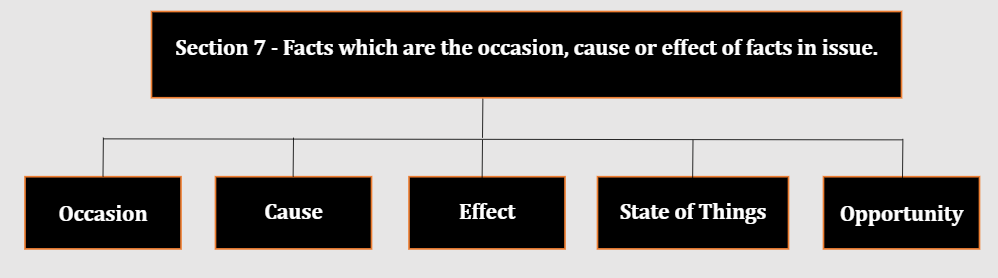
Facts which are the Occasion, Cause or Effect of Facts in Issue - Section 7
Facts which are the occasion, cause, or effect, immediate or otherwise, of relevant facts, or facts in issue, or which constitute the state of things under which they happened, or which afforded an opportunity for their occurrence or transaction, are relevant.
It can be explained by following illustrations:
- The question is whether A robbed B. The facts that, shortly before the robbery, B went to a fair with money in his possession, and that he showed it or mentioned the fact that he had it, to third persons, are relevant.
- The question is, whether A murdered B. Marks on the ground, produced by a struggle at or near the place where the murder was committed, are relevant facts.
- The question is whether A poisoned B. The state of B's health before the symptoms ascribed to poison, and habits of B, known to A, which afforded an opportunity for the administration of poison, are the relevant facts.
Case Laws:
- R v. Richardson (1758): In this English case the deceased girl was alone in her cottage. Being alone was considered to be an occasion for murder.
Motive, Preparation and Previous or Subsequent Conduct - Section 8
It provides that:
- Any fact is relevant which shows or constitutes a motive or preparation for any fact in issue or relevant fact.
- The conduct of any party, or of any agent to any party, to any suit or proceeding, in reference to such suit or proceeding, or in reference to a fact in issue therein or relevant thereto, and the conduct of any person an offence against whom is the subject of any proceeding, is relevant, if such conduct influences or is influenced by any fact in issue or relevant fact, and whether it was previous or subsequent thereto.
Explanation 1-The word "conduct" in this Section does not include statements, unless those statements accompany and explain acts other than statements, but this explanation is not to affect the relevancy of statements under any other section of this Act.
Explanation 2.-When the conduct of any person is relevant, any statement made to him or in his presence and hearing, which affects such conduct, is relevant.
It can be explained by following illustrations:
(a) A is tried for the murder of B.
The facts that A murdered C, that B knew that A had murdered C, and that B had tried to extort money from A by threatening to make his knowledge public, are relevant.
(b) A sues B upon a bond for the payment of money. B denies the making of the bond. The fact that, at the time when the bond was alleged to be made, B required money for a particular purpose, is relevant.
(c) A is tried for the murder of B by poison.
The fact that, before the death of B, A procured poison similar to that which was administered to B, is relevant.
(k) The question is, whether A was robbed.
The fact that, soon after the alleged robbery, he made a complaint relating to the offence, the circumstances under which, and the terms in which, the complaint was made, are relevant.
The fact that he said he had been robbed, without making any complaint, is not relevant, as conduct under this section, though it may be relevant as a dying declaration under section 32, clause (1), or as corroborative evidence under section 157.
- Constituents of this Section
-
- Motive
-
-
- Motive is something which compels a man to do a particular act. It primarily refers to the underlying reason or purpose that drives a person to commit a crime.
- In the case of Tara Devi v. State of UP (1991): SC held that previous threats, previous altercations, or previous litigations between parties are admitted to show motive. The mere existence of motive is by itself not an incriminating circumstance.
-
-
- Preparation
-
-
- Evidence indicating the preparation for the commission of a crime is consistently admissible. The persuasive value of both preparation and prior attempts relies on the presumption that the accused formed an intention to commit an offense, and this intention persisted until the means and opportunity were discovered to carry it out.
-
-
- Conduct
-
-
- Conduct refers to the outward actions and behaviors of an individual, while character can be described as the perception or impression that others have of a person.
- In the case of R.M.Malkani v. State of Maharasthra (1973): Conversation over telephone for settling details for passing bribe- money was recorded by secret instruments, was held to be evidence of conduct.
-
Facts Necessary to Explain or Introduce Relevant Facts - Section 9
The provision talks about things:
- Necessary to explain or introduce a fact in issue or relevant fact, or
- Which support or rebut an inference suggested by such a fact, or
- Which establish the identity of anything or person where identity is relevant, or
- Which fix the time or place at which any fact in issue or relevant fact happened, or
- Which show the relations of parties by whom any such fact was transacted.
It can be explained by following illustrations:
(a) The question is, whether a given document is the will of A. The state of A's property and of his family at the date of the alleged will may be relevant facts.
(b) A sues B for a libel imputing disgraceful conduct to A; B affirms that the matter alleged to be libellous is true.
The position and relations of the parties at the time when the libel was published may be relevant facts as introductory to the facts in issue.
The particulars of a dispute between A and B about a matter unconnected with the alleged libel are irrelevant though the fact that there was a dispute may be relevant if it affected the relations between A and B.
Test Identification Parade (TIP) under Section 9
- TIP - It involves presenting a witness or a victim with a group of individuals, including the suspect, to determine if they can identify the perpetrator of a crime. This procedure is often used to establish or confirm the identity of a suspect in criminal cases. The TIP is meant to test the veracity of the witness and his capacity to identify unknown person.
- Ramanathan v. State of Tamil Nadu (1978): SC stated that the common and old practice of lining-up suspects for identification by eyewitnesses or by the victim becomes essential where the identity of the perpetrator is unknown.
- Mulla v. State of Uttar Pradesh (2010): The SC in this matter held that where the identification of the accused by witness is done for the first time in the court, it should not form the basis of the conviction.
Case Laws
- Sainudeen v. State of Kerala (1990): Kerela High Court held that Identification of the accused through his voice was relevant under this Section.
- Hardayal v. State of UP (1976): SC held that evidence of other offences committed by the accused is admitted in order to establish his identity or to corroborate the testimony of a witness in a material particular.
Facts Showing the Existence of a State of Mind, or of Body or Bodily Feeling - Section -14
Facts showing the existence of any state of mind, such as intention, knowledge, good faith, negligence, rashness, ill-will or good-will towards any particular person, or showing the existence of any state of the body or bodily feeling, are relevant, when the existence of any such state of mind or body or bodily feeling, is in issue or relevant.
Explanation 1 - A fact relevant as showing the existence of a relevant state of mind must show that the state of mind exists, not generally, but in reference to the particular matter in question.
Explanation 2 - But where, upon the trial of a person accused of an offence, the previous commission by the accused of an offence is relevant within the meaning of this Section, the previous conviction of such person shall also be a relevant fact.
It can be explained by following illustrations:
(a) A is accused of receiving stolen goods knowing them to be stolen. It is proved that he was in possession of a particular stolen article.
The fact that, at the same time, he was in possession of many other stolen articles is relevant, as it tends to show that he knew each and all of the articles of which he was in possession, to be stolen.
(b) A is accused of fraudulently delivering to another person a counterfeit coin which, at the time when he delivered it, he knew to be counterfeit.
The fact that, at the time of its delivery, A was possessed of a number of other pieces of counterfeit coin is relevant.
The fact that A had been previously convicted of delivering to another person as genuine a counterfeit coin knowing it to be counterfeit is relevant.
(c) A sues B for damage done by a dog of B's which B knew to be ferocious.
The facts that the dog had previously bitten X, Y, and Z, and that they had made complaints to B, are relevant.
(d) A is accused of defaming B by publishing an imputation intended to harm the reputation of B.
The fact of previous publications by A respecting B, showing ill-will on the part of A towards B, is relevant, as proving A's intention to harm B's reputation by the particular publication in question.
The facts that there was no previous quarrel between A and B, and that A repeated the matter complained of as he heard it, are relevant, as showing that A did not intend to harm the reputation of B.
(g) A is charged with shooting at B with intent to kill him. In order to show A's intent, the fact of A's having previously shot at B may be proved.
(i) The question is, whether A's death was caused by poison.
Statements made by A during his illness as to his symptoms are relevant facts.
(j) A sues B for negligence in providing him with a carriage for hire not reasonably fit for use, whereby A was injured.
The fact that B's attention was drawn on other occasions to the defect of that particular carriage, is relevant.
The fact that B was habitually negligent about the carriages which he let to hire is irrelevant.
Ingredients
Under Section 14, the fact showing the existence of any state of -
- Mind (e.g., intention, knowledge, good faith, negligence, rashness, ill-will, good will) or
- Body
- Bodily feelings are relevant when the existence of any such state of mind or bodily feeling is at issue or relevant.
Other Relevant Facts
The IEA provides other relevant facts under Sections 10, 11, 12, 13, 15, 16 as well.
- Facts necessary to explain or introduce relevant facts. (Section 10)
- When facts not otherwise relevant become relevant. (Section 11)
- In suits for damages, facts tending to enable Court to determine amount are relevant. (Section 12)
- Facts relevant when right or custom is in question. (Section 13)
- Facts bearing on question whether act was accidental or intentional. (Section 15)
- Existence of course of business when relevant. (Section 16)