

-
- Books & Magazines
- Login
- Language: Eng हिंदी
List of Current Affairs
Home / List of Current Affairs
Criminal Law
Mere Breaking Up of Relationship Not 'Instigation' For Abetment of Suicide
25-Feb-2026
|
"Though broken relationship and heartbreaks have become common these days, mere breaking-up of relationship may not per se constitute instigation so as to make it to be a case of abetment under Section 108 BNS." Justice Manoj Jain |
Source: Delhi High Court
Why in News?
Justice Manoj Jain of the Delhi High Court, in the case of Noor Mohammad v. State NCT of Delhi (2026), held that merely breaking up a relationship does not per se constitute "instigation" to make out an offence of abetment of suicide under Section 108 of the Bharatiya Nyaya Sanhita (BNS), 2023 (corresponding to Section 306 IPC). The Court granted regular bail to a university professor accused of abetting the suicide of a 27-year-old woman.
What was the Background of Noor Mohammad v. State NCT of Delhi (2026) Case?
- The case arose from the suicide of a 27-year-old school teacher, who allegedly hanged herself at her residence on October 24, 2025.
- The next day, the deceased's father lodged an FIR alleging that the accused — a university professor — had abetted her suicide by coercing her to convert her religion as a precondition for marriage.
- According to the complainant, the deceased had come into contact with the accused during her academic pursuits, following which he established a relationship with her and later began pressurising her to convert, causing her severe mental stress.
- The accused was arrested on November 14, 2025.
- The accused approached the Delhi High Court seeking regular bail, contesting that the ingredients of abetment of suicide were not made out against him.
What were the Court's Observations?
- Justice Manoj Jain noted that there was no dying declaration on record that could shed light on the state of mind of the deceased at the time she took the extreme step of ending her life.
- The Court observed that the parties had been in a relationship for around eight years, during which period no complaint was filed by the deceased.
- The Court noted that the diaries recovered from the house of the deceased appeared to reflect her personal manifestations — as someone in a love relationship who merely wished to transform her desire into reality.
- Justice Jain found it to be a case of a broken relationship, wherein the deceased, having come to know that the accused had married someone else, chose to end her life.
- The Court held that instigation means to provoke, incite, or encourage a person to do an act, and to establish abetment or instigation, there must be a clear mens rea on the part of the accused.
- The Court further clarified that instigation must be of such a nature that it leaves the deceased with no option but to commit suicide.
- The Court observed that "though broken relationship and heartbreaks have become common these days, mere breaking-up of relationship may not per se constitute instigation so as to make it to be a case of abetment under Section 108 BNS (corresponding Section 306 IPC)."
- Taking note of the completion of investigation, the filing of the chargesheet, and the accused's roots in society, the Court granted him regular bail subject to furnishing a personal bond and surety bond of ₹25,000 each.
What is the Abetment of Suicide?
Legal Definition and Framework:
- Abetment of suicide is defined under Section 107 of the Indian Penal Code, 1860 (now Section 45 of the Bharatiya Nyaya Sanhita, 2023).
- The offence involves deliberate acts that facilitate or encourage another person to commit suicide.
Three Essential Components of Abetment:
- Direct Instigation: This involves actively encouraging, provoking, or urging a person to commit suicide through words, gestures, or conduct that would incite the victim to take their own life.
- Conspiracy: This occurs when two or more persons engage in a conspiracy to facilitate suicide, and some act or illegal omission takes place in pursuance of that conspiracy.
- Intentional Aid: This involves providing assistance through any act or illegal omission that helps the person commit suicide, including willful misrepresentation or concealment of material facts.
Legal Provisions and Penalties:
Under Section 108 BNS (Section 306 IPC), abetment of suicide carries:
- Imprisonment of either description for up to 10 years.
- Additional fine as monetary penalty.
- The offence is cognizable, non-bailable, and non-compoundable.
- Cases are tried in Sessions Courts.
Special Provisions for Vulnerable Persons:
Section 107 BNS provides enhanced punishment when the victim is a child, person of unsound mind, delirious person, or intoxicated person. In such cases, the punishment extends to death penalty or life imprisonment, or imprisonment up to ten years with fine.
Burden of Proof Requirements:
- Direct Causation: There must be clear evidence linking the accused's actions to the victim's decision to commit suicide.
- Specific Intent: The accused must have intended their actions to drive the person to suicide, not merely cause general distress.
- Proximate Connection: Courts require evidence of acts occurring close in time to the suicide that directly compelled the victim to take the extreme step.
- Active Participation: Mere passive presence or general harassment is insufficient; there must be positive acts of instigation or aid.
Key Legal Distinctions:
- What Constitutes Abetment: Active instigation with intent to cause suicide, conspiracy to facilitate suicide, or intentional aid in the commission of suicide.
- What Does Not Constitute Abetment: General harassment, professional pressure without specific suicidal intent, workplace stress, marital discord without proximate instigation, or emotional distress from ordinary life conflicts.
Case Laws:
Madan Mohan Singh v. State of Gujarat (2010):
- In this case, the accused was alleged to have continuously harassed and insulted the deceased. The deceased was a driver who left behind a suicide note accusing his employer of driving him to suicide through persistent harassment and insulting behavior.
- The Supreme Court held that despite the existence of a suicide note directly blaming the accused employer, there was absolutely nothing in either the suicide note or the First Information Report that could even distantly be viewed as constituting an offence under Section 306 of the Indian Penal Code.
- The court established that mere allegations of continuous harassment and insults, even when documented in a suicide note, are insufficient to constitute the offence of abetment to suicide without specific acts of instigation that directly led to the extreme step.
Amalendu Pal v. State of West Bengal (2010):
- The Supreme Court in this case laid down a crucial principle regarding the requirement of proximate causation in abetment to suicide cases.
- The court held that "merely on the allegation of harassment without there being any positive action proximate to the time of occurrence on the part of the accused which led or compelled the person to commit suicide, conviction in terms of Section 306 IPC is not sustainable."
- This judgment established that there must be a clear temporal connection between the accused's actions and the suicide. The court emphasized that harassment allegations alone, without demonstrable positive acts occurring close to the time of suicide that directly compelled the victim to take the extreme step, cannot sustain a conviction for abetment.
- Both cases reinforced the principle that the prosecution must establish not just harassment, but specific acts of instigation with proximate causation to prove abetment to suicide under Section 306 IPC.
Criminal Law
No Offence for Inverted Flag Display Without Intent to Insult
25-Feb-2026
|
"The Applicant's mere presence at the place of hoisting of the Flag, as alleged, would not amount to an offence under Section 2(4)(l) of the Prevention of Insults to National Honour Act, 1971." Justice Ashwin Bhobe |
Source: Bombay High Court
Why in News?
A single-judge bench of Justice Ashwin Bhobe of the Bombay High Court, in the case of VK Narayanan v. State of Maharashtra (2026), held that to constitute an offence under Section 2(4)(l) of the Prevention of Insults to National Honour Act, 1971, the display of the Indian National Flag in an inverted manner must be intentional — mere presence at the site of hoisting is insufficient to establish guilt.
What was the Background of VK Narayanan v. State of Maharashtra (2026) Case?
- The case arose from Republic Day celebrations held in 2017 at a residential society in Tilak Nagar, Chembur, Mumbai.
- During the celebrations, the Indian National Flag was hoisted on the building's terrace in an inverted position — with the saffron stripe facing downward instead of upward.
- The Mumbai Police lodged an FIR against VK Narayanan, then 85 years old, and other senior citizen members of the society under Section 2(4)(1) of the Prevention of Insults to National Honour Act, 1971.
- The prosecution's primary evidence rested on the statement of a watchman of the society, who stated that Narayanan was merely present on the terrace along with other society members during the hoisting.
- A Magistrate Court took cognisance of the Mumbai Police's chargesheet and issued process against the petitioner and other named persons by an order dated July 3, 2017.
- Narayanan challenged the FIR and chargesheet before the Bombay High Court, and in the course of proceedings, he tendered an unconditional apology to the court as suggested by the bench, given his advanced age.
What were the Court's Observations?
- Justice Bhobe held that the offence under Section 2(4)(l) of the Act requires mens rea — that is, an intention or deliberate act to insult or show disrespect to the honour of the Indian National Flag, or to bring it into contempt.
- The Court observed that neither the watchman's statement nor any other material collected by the prosecution indicated that Narayanan hoisted or displayed the flag, or was in any manner involved in its display on January 26, 2017.
- The Court further held that even accepting all the allegations and evidence in the FIR as true and correct, nothing on record suggested that the petitioner displayed the flag in an inverted manner, much less that he harboured any intention to do so.
- On the Magistrate's order taking cognisance and issuing process, the Court was sharply critical, characterising it as a "rubber-stamped cognisance" — meaning the Magistrate mechanically passed the order without proper application of judicial mind.
- Accordingly, the Court quashed both the FIR and the chargesheet filed against Narayanan.
What is the Prevention of Insults to National Honour Act, 1971?
About:
- The Prevention of Insults to National Honour Act, 1971 is a central legislation enacted to protect the dignity and honour of the Indian National Flag, the Constitution of India, and the National Anthem.
- The Act criminalises acts that insult, show disrespect to, or bring into contempt these national symbols, whether through burning, mutilation, defacement, disfigurement, or other deliberate acts.
Section 2 — Insults to Indian National Flag and Constitution of India:
- Any person who in any public place or in any other place within public view burns, mutilates, defaces, defiles, disfigures, destroys, tramples upon or otherwise shows disrespect to or brings into contempt the Indian National Flag or the Constitution of India shall be punishable.
Punishment:
- Imprisonment up to three years, or a fine, or both.
Inverted Display — Section 2(4)(l):
- Displaying the Indian National Flag with the saffron stripe downward — i.e., in an inverted position — is specifically prohibited as a form of insult to the flag.
- As clarified by this judgment, such display must be intentional to attract criminal liability; accidental or inadvertent inversion without any intent to insult does not constitute the offence.
What are the Key Facts About the Indian National Flag?
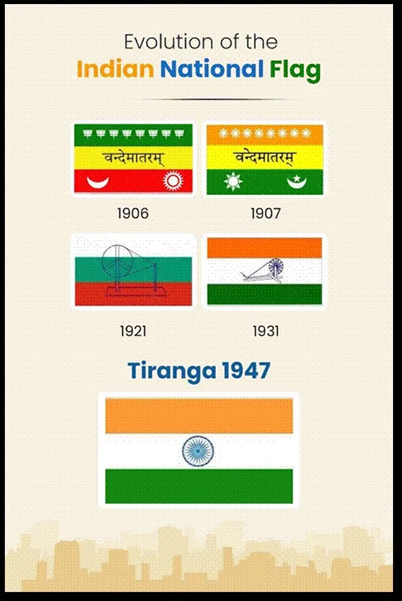
Evolution of the Indian National Flag:
- 1904: Designed by Sister Nivedita, it featured red and yellow with a Vajra (strength), a white lotus (purity), and "Bande Mataram" inscribed.
- Sister Nivedita was an Irish social activist and a disciple of Swami Vivekananda.
- 1906 (Swadeshi Movement Flag): Considered the first tricolour, it was hoisted in Calcutta with green, yellow, and red horizontal stripes. It featured lotuses, a sun, a crescent moon, and the words "Vande Mataram".
- 1907 (Saptarishi Flag): Hoisted by Madam Bhikaji Cama in Germany. It had green, saffron, and red stripes with lotuses, "Vande Mataram", a sun, and a crescent moon.
- 1917 (Home Rule Movement Flag): Introduced by Annie Besant and Tilak. It had red and green stripes, the Union Jack, crescent and star, and stars in the Saptarishi pattern.
- 1921: Pingali Venkayya (an Indian freedom fighter, linguist, and polymath from Andhra Pradesh), proposed a red, white, and green flag with a spinning wheel, symbolising unity and self-reliance. The design of the present Indian flag is largely attributed to him.
- In 1931 Saffron replaced red. The flag had saffron, white, and green with a spinning wheel in the centre. It was adopted by the Indian National Congress.
- 1947 (Present Flag): Adopted by the Constituent Assembly. The spinning wheel was replaced with the Ashoka Chakra.
- Common name: Tiranga, meaning Tricolour.
- Design: Three horizontal stripes: saffron (kesari) (top), White (middle), Green (bottom), with a navy blue Ashoka Chakra in the centre.
- Ashoka Chakra: The Ashoka Chakra, with 24 spokes, is based on the wheel from the Sarnath Lion Capital made by the 3rd-century BC Mauryan Emperor Ashoka and fits within the width of the white band.
- Symbolism:
- Saffron: Strength and Courage of the Country.
- White: Purity, Truth, and Peace.
- Green: Fertility, growth, and prosperity, reflecting India’s agricultural roots and environmental commitment.
- Ashoka Chakra (known as the “wheel of law”): Represents Law, justice, and the cycle of life. The chakra intends to show that there is life in movement and death in stagnation.
- Flag dimensions: 3:2 ratio (length to height).
- Regulation: Governed by the Flag Code of India, 2002 which sets rules for display, handling, and respect for the flag.
- Article 51A(a) of the Indian Constitution mandates that it is the fundamental duty of every citizen to respect the National Flag and National Anthem.
- The Prevention of Insults to National Honour Act, 1971, punishes offences related to disrespecting the national flag or anthem.
- Material: Traditionally made from hand-spun khadi (cotton), symbolising self-reliance. In 2021, the Flag Code of India, 2002 was amended to allow the national flag to be made from other approved materials, including machine-made and polyester flags.
Note: The National Flag in possession of the Archaeological Survey of India at Fort St George Museum in Chennai is known as the oldest surviving Indian national flag. It was hoisted at Fort St George in Chennai on 15th August 1947.