


-
- Books & Magazines
- Login
- Language: Eng हिंदी
Home / Current Affairs
Criminal Law
No Offence for Inverted Flag Display Without Intent to Insult
« »25-Feb-2026
|
"The Applicant's mere presence at the place of hoisting of the Flag, as alleged, would not amount to an offence under Section 2(4)(l) of the Prevention of Insults to National Honour Act, 1971." Justice Ashwin Bhobe |
Source: Bombay High Court
Why in News?
A single-judge bench of Justice Ashwin Bhobe of the Bombay High Court, in the case of VK Narayanan v. State of Maharashtra (2026), held that to constitute an offence under Section 2(4)(l) of the Prevention of Insults to National Honour Act, 1971, the display of the Indian National Flag in an inverted manner must be intentional — mere presence at the site of hoisting is insufficient to establish guilt.
What was the Background of VK Narayanan v. State of Maharashtra (2026) Case?
- The case arose from Republic Day celebrations held in 2017 at a residential society in Tilak Nagar, Chembur, Mumbai.
- During the celebrations, the Indian National Flag was hoisted on the building's terrace in an inverted position — with the saffron stripe facing downward instead of upward.
- The Mumbai Police lodged an FIR against VK Narayanan, then 85 years old, and other senior citizen members of the society under Section 2(4)(1) of the Prevention of Insults to National Honour Act, 1971.
- The prosecution's primary evidence rested on the statement of a watchman of the society, who stated that Narayanan was merely present on the terrace along with other society members during the hoisting.
- A Magistrate Court took cognisance of the Mumbai Police's chargesheet and issued process against the petitioner and other named persons by an order dated July 3, 2017.
- Narayanan challenged the FIR and chargesheet before the Bombay High Court, and in the course of proceedings, he tendered an unconditional apology to the court as suggested by the bench, given his advanced age.
What were the Court's Observations?
- Justice Bhobe held that the offence under Section 2(4)(l) of the Act requires mens rea — that is, an intention or deliberate act to insult or show disrespect to the honour of the Indian National Flag, or to bring it into contempt.
- The Court observed that neither the watchman's statement nor any other material collected by the prosecution indicated that Narayanan hoisted or displayed the flag, or was in any manner involved in its display on January 26, 2017.
- The Court further held that even accepting all the allegations and evidence in the FIR as true and correct, nothing on record suggested that the petitioner displayed the flag in an inverted manner, much less that he harboured any intention to do so.
- On the Magistrate's order taking cognisance and issuing process, the Court was sharply critical, characterising it as a "rubber-stamped cognisance" — meaning the Magistrate mechanically passed the order without proper application of judicial mind.
- Accordingly, the Court quashed both the FIR and the chargesheet filed against Narayanan.
What is the Prevention of Insults to National Honour Act, 1971?
About:
- The Prevention of Insults to National Honour Act, 1971 is a central legislation enacted to protect the dignity and honour of the Indian National Flag, the Constitution of India, and the National Anthem.
- The Act criminalises acts that insult, show disrespect to, or bring into contempt these national symbols, whether through burning, mutilation, defacement, disfigurement, or other deliberate acts.
Section 2 — Insults to Indian National Flag and Constitution of India:
- Any person who in any public place or in any other place within public view burns, mutilates, defaces, defiles, disfigures, destroys, tramples upon or otherwise shows disrespect to or brings into contempt the Indian National Flag or the Constitution of India shall be punishable.
Punishment:
- Imprisonment up to three years, or a fine, or both.
Inverted Display — Section 2(4)(l):
- Displaying the Indian National Flag with the saffron stripe downward — i.e., in an inverted position — is specifically prohibited as a form of insult to the flag.
- As clarified by this judgment, such display must be intentional to attract criminal liability; accidental or inadvertent inversion without any intent to insult does not constitute the offence.
What are the Key Facts About the Indian National Flag?
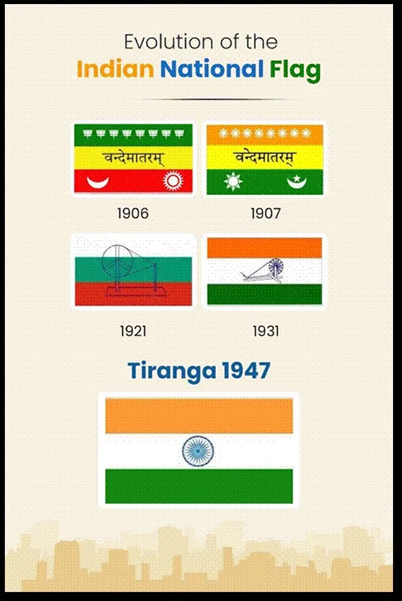
Evolution of the Indian National Flag:
- 1904: Designed by Sister Nivedita, it featured red and yellow with a Vajra (strength), a white lotus (purity), and "Bande Mataram" inscribed.
- Sister Nivedita was an Irish social activist and a disciple of Swami Vivekananda.
- 1906 (Swadeshi Movement Flag): Considered the first tricolour, it was hoisted in Calcutta with green, yellow, and red horizontal stripes. It featured lotuses, a sun, a crescent moon, and the words "Vande Mataram".
- 1907 (Saptarishi Flag): Hoisted by Madam Bhikaji Cama in Germany. It had green, saffron, and red stripes with lotuses, "Vande Mataram", a sun, and a crescent moon.
- 1917 (Home Rule Movement Flag): Introduced by Annie Besant and Tilak. It had red and green stripes, the Union Jack, crescent and star, and stars in the Saptarishi pattern.
- 1921: Pingali Venkayya (an Indian freedom fighter, linguist, and polymath from Andhra Pradesh), proposed a red, white, and green flag with a spinning wheel, symbolising unity and self-reliance. The design of the present Indian flag is largely attributed to him.
- In 1931 Saffron replaced red. The flag had saffron, white, and green with a spinning wheel in the centre. It was adopted by the Indian National Congress.
- 1947 (Present Flag): Adopted by the Constituent Assembly. The spinning wheel was replaced with the Ashoka Chakra.
- Common name: Tiranga, meaning Tricolour.
- Design: Three horizontal stripes: saffron (kesari) (top), White (middle), Green (bottom), with a navy blue Ashoka Chakra in the centre.
- Ashoka Chakra: The Ashoka Chakra, with 24 spokes, is based on the wheel from the Sarnath Lion Capital made by the 3rd-century BC Mauryan Emperor Ashoka and fits within the width of the white band.
- Symbolism:
- Saffron: Strength and Courage of the Country.
- White: Purity, Truth, and Peace.
- Green: Fertility, growth, and prosperity, reflecting India’s agricultural roots and environmental commitment.
- Ashoka Chakra (known as the “wheel of law”): Represents Law, justice, and the cycle of life. The chakra intends to show that there is life in movement and death in stagnation.
- Flag dimensions: 3:2 ratio (length to height).
- Regulation: Governed by the Flag Code of India, 2002 which sets rules for display, handling, and respect for the flag.
- Article 51A(a) of the Indian Constitution mandates that it is the fundamental duty of every citizen to respect the National Flag and National Anthem.
- The Prevention of Insults to National Honour Act, 1971, punishes offences related to disrespecting the national flag or anthem.
- Material: Traditionally made from hand-spun khadi (cotton), symbolising self-reliance. In 2021, the Flag Code of India, 2002 was amended to allow the national flag to be made from other approved materials, including machine-made and polyester flags.
Note: The National Flag in possession of the Archaeological Survey of India at Fort St George Museum in Chennai is known as the oldest surviving Indian national flag. It was hoisted at Fort St George in Chennai on 15th August 1947.