


List of Current Affairs
Home / List of Current Affairs
Constitutional Law
No Quota for Judicial Officers in District Judge Posts
20-Nov-2025
Source: Supreme Court
Why in News?
The 5-judge bench led by Chief Justice of India BR Gavai, comprising Justices Surya Kant, Vikram Nath, K Vinod Chandran and Joymalya Bagchi delivered judgment in the All-India Judges Association & Ors. v. Union of India (2025), ruling out any special quota for promotee judges in District Judge posts and issuing comprehensive guidelines on seniority in Higher Judicial Service.

What was the Background of All India Judges Association & Ors. v. Union of India (2025) Case?
- The bench was examining whether there should be a quota in District Judge posts for promotion of judicial officers who joined at entry level to address career stagnation.
- Senior Advocate Siddharth Bhatnagar, appointed as amicus curiae, had highlighted an anomalous situation where Judicial Officers recruited as Judicial Magistrate First Class often do not reach even the level of Principal District Judge.
- The amicus stated this situation discouraged bright youngsters from joining the judiciary.
- The reference was made to the larger bench to consider a proposal to reserve certain percentage of posts from Principal District Judge cadre for promotion of judges initially selected from JMFC cadre.
- Senior Advocate R Basant opposed this proposal, arguing it would deny opportunities to meritorious candidates waiting for direct recruitment as District Judges.
- The reference order observed that judges initially appointed as Civil Judges gain rich experience through decades of service, and every judicial officer aspires to reach at least the position of High Court Judge.
- The issue involved consideration of judgments passed by three-judge benches, necessitating a Constitution Bench of five judges.
What were the Court’s Observations?
- The Court ruled out special quota or weightage for promotee judges in District Judge posts, observing no nationwide pattern of disproportionate representation of direct recruits in Higher Judicial Service.
- The bench observed that perceived feeling of heartburn among judicial officers cannot justify creation of artificial classification within Higher Judicial Service cadre.
- On entry into common cadre from different sources and assignment of seniority as per annual roster, incumbents lose their birthmark of the source from which they are recruited.
- Fixation in Selection Grade and Super Time Scale within HJS is based on merit-cum-seniority within the cadre and cannot depend upon length of service or performance in lower rungs of Judiciary.
- The length and performance as Civil Judge does not constitute an intelligible differentia to classify incumbents in common cadre of District Judge.
- In-service judicial officers have enough opportunities for advancement as District Judges, especially after the Rejanish judgment allowing them to contest for direct recruitment as District Judges.
- Fast track promotions as Civil Judge Senior Division are facilitated with reduction of service period condition.
- Individual aspirations are common incidence of any service and cannot guide seniority rules.
What are the Supreme Court Guidelines on Seniority?
The Court issued guidelines for filling up District Judge posts invoking powers under Article 142 of the Constitution of India, 1950(COI).
Guideline 1: Seniority of officers within HJS shall be determined through an annual 4-point roster, filled by all officers appointed in particular year in repeating sequence of 2 Regular Promotees, 1 LDCE, and 1 Direct Recruit.
Guideline 2: Only if recruitment process is completed within the year after which it was initiated and no other appointments from any three sources have already taken place for that subsequent year, shall officers belatedly appointed be entitled to seniority as per roster of year in which recruitment was initiated.
Guideline 3: If recruitment process is not initiated for vacancies arising in given year in same year, candidate filling such vacancy in subsequent recruitment shall be granted seniority within annual roster of year in which recruitment process is finally concluded and appointment is made.
Guideline 4: After recruitment of Direct Recruits and LDCEs is complete for particular year, positions falling in their quota that remain unfilled due to lack of suitable candidates shall be filled through Regular Promotees, subject to placement only on subsequent Regular Promotee positions in annual roster, and vacancies in subsequent year shall be computed to apply proportion of 50:25:25 to entire cadre.
Guideline 5: Statutory rules governing HJS in respective States, in consultation with High Courts, shall prescribe exact modalities of Annual Roster and implementation of judgment directions.
Additional Court Clarifications:
- The guidelines are not intended to resolve any inter-se dispute but are general and mandatory to be incorporated into regulations governing inter-se seniority of higher judicial services.
- The guidelines will not reopen any decided issues related to inter-se seniority disputes.
- The guidelines are being issued considering the present situation and could be revisited or modified in future.
What is Higher Judicial Service?
About:
- Higher Judicial Service refers to the cadre of District Judges in the Indian judicial system.
- Entry into HJS is through three sources: Regular Promotion from Civil Judge cadre, Limited Departmental Competitive Examination, and Direct Recruitment.
- The cadre strength ratio maintained is 50:25:25 for Regular Promotees, LDCE, and Direct Recruits respectively.
Career Progression:
- Officers in HJS can advance to positions like District Judge Selection Grade, District Judge Super Time Scale, and Principal District Judge.
- Advancement is based on merit-cum-seniority principle within the cadre.
- After the Rejanish judgment, in-service judicial officers can also contest for direct recruitment as District Judges, providing additional advancement opportunities.
Seniority Determination:
- Previously, seniority determination varied across states leading to disputes and career stagnation concerns.
- The new guidelines establish uniform annual roster system across all states for consistent seniority determination.
- The annual roster ensures proportionate representation from all three sources of recruitment in the HJS cadre.
What is Article 142 of the COI?
- Article 142 of COI provides for enforcement of decrees and orders of Supreme Court and orders as to discovery.
- Article 142 (1) provides that the Supreme Court in the exercise of its jurisdiction may pass such decree or make such order as is necessary for doing complete justice in any cause or matter pending before it, and any decree so passed or order so made shall be enforceable throughout the territory of India in such manner as may be prescribed by or under any law made by Parliament and, until provision in that behalf is so made, in such manner as the President may by order prescribe.
- Article 142 (2) provides that subject to the provisions of any law made in this behalf by Parliament, the Supreme Court shall, as respects the whole of the territory of India, have all and every power to make any order for the purpose of securing the attendance of any person, the discovery or production of any documents, or the investigation or punishment of any contempt of itself.
- Over the years this provision has been used for primarily used for two purposes : firstly, to do “complete justice” in a given case and secondly to fill what the Court perceives as the legislative gaps.
Constitutional Law
Tribunal Reforms Act 2021 declared Void
20-Nov-2025
Source: Supreme Court
Why in News?
The bench of Chief Justice of India BR Gavai and Justice K Vinod Chandran in the case of Madras Bar Association v. Union of India (2025) struck down the Tribunal Reforms Act, 2021, relating to appointments, tenure, and service conditions of tribunal members as unconstitutional.
What was the Background of Madras Bar Association v. Union of India (2025) Case?
- The petition was filed by the Madras Bar Association in 2021 challenging the Tribunal Reforms Act, 2021.
- In the 2020 Madras Bar Association case (MBA IV), the Supreme Court had struck down the Tribunal Rules 2020.
- In the 2021 Madras Bar Association case (MBA V), the Court struck down the Tribunal Reforms Ordinance 2021.
- In these earlier judgments, the Court had mandated that tribunal members should have at least 5-year tenure, and that lawyers having a minimum 10 years of experience must be considered for appointments.
- However, the 2021 Act prescribed only a 4-year tenure and imposed a minimum age limit of 50 years for appointments.
- The Act also prescribed that the search-cum-selection committee would recommend two persons for the post of Chairperson, deviating from earlier judgments.
- The Act fixed allowances and benefits to those of equivalent civil servants and imposed upper age caps of 70/67 years.
- The petitioner argued that the Act was contrary to previous Supreme Court judgments and violated principles of judicial independence.
- The Union Government filed an application seeking to refer the matter to a larger bench, which was rejected by the Court.
- The judgment was reserved on November 11, 2025, and pronounced on November 19, 2025.
What were the Court's Observations?
- The Court held that the provisions violate constitutional principles of separation of powers and judicial independence, which are firmly embedded in the Constitution.
- The judgment emphasized that Parliament cannot override judicial decisions by re-enacting the same measure in different form without addressing constitutional defects.
- The bench stated that the Act "merely reproduces, in slightly altered form, the very provisions earlier struck down" which amounts to legislative override.
- The Court rejected the Union's argument that a law cannot be tested on "abstract principles" such as judicial independence and separation of powers.
- The minimum age bar of fifty years, truncated four-year tenure with upper age caps, requirement to recommend two names for Chairperson, and fixing allowances to civil servant equivalents were all struck down as arbitrary.
- During hearings, CJI BR Gavai expressed displeasure at the Attorney General for seeking larger bench reference and adjournments, questioning if it was a "tactic" to delay the hearing till the CJI's retirement.
- The Court directed that until Parliament enacts a new Act, the directions given in MBA IV and MBA V cases will continue to operate.
- The Court directed the Union to form a National Tribunal Commission within four months.
- Appointments whose selection was completed before the Act commenced but whose formal notifications were issued afterward shall be protected and governed by parent statutes and MBA IV/V conditions.
What is the Tribunals Reforms Act, 2021?
About:
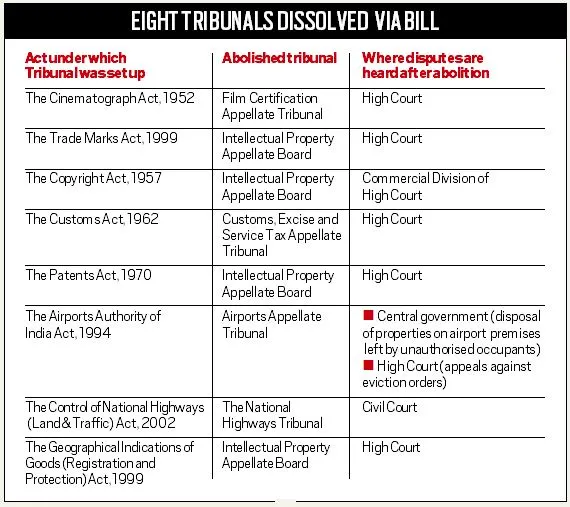
- The Act was enacted to streamline the functioning of tribunals by dissolving certain appellate tribunals and transferring their functions to existing judicial bodies like the High Courts.
- It was introduced in response to the Supreme Court's ruling in the case of Madras Bar Association vs. Union of India (2021), which struck down certain provisions of the Tribunal Reforms (Rationalisation and Conditions of Service) Ordinance, 2021.
Key Provisions:
- Abolition of Tribunal: The Act dissolves multiple appellate tribunals and shifts their functions to High Courts and other judicial bodies.
- Search-cum-Selection Committee: It has been established to recommend the appointment of tribunal chairpersons and members.
- For Central Tribunals:
- Chairperson: Chief Justice of India (CJI) or a Supreme Court judge nominated by the CJI (casting vote).
- Two Secretaries nominated by the Central Government.
- Sitting/outgoing Chairperson of the tribunal, or a retired Supreme Court judge, or a retired Chief Justice of a High Court.
- Non-voting member: Secretary of the relevant Union Ministry.
- For State Administrative Tribunals:
- Chairperson: Chief Justice of the respective High Court (casting vote).
- Chief Secretary of the State Government.
- Chairman of the State Public Service Commission.
- Sitting/outgoing Chairperson of the Tribunal or a retired High Court Judge.
- Tenure and Age Limits: Tenure for Chairperson and Members 4 years, with a minimum age of 50 years.
- The maximum age limit is 67 years for tribunal members and 70 years for chairpersons, or completion of the 4-year tenure, whichever is earlier.
- Tribunal Chairpersons and Members are eligible for reappointment, with preference given to their past service.
- Removal of Tribunal Members: Central government on the recommendation of the Search-cum-Selection Committee can remove Chairperson or a Member.
What are Tribunals?
A tribunal is a quasi-judicial institution that is set up to deal with problems such as resolving administrative or tax-related disputes. The original Constitution did not contain provisions with respect to tribunals. The 42nd Amendment Act of 1976 added a new Part XIV-A to the
- Part XIV-A is entitled as Tribunals and consists of two Articles namely Article 323A and 323B.
- Article 323-A: Deals with Administrative Tribunals for public service matters.
- Article 323-B: Provides for tribunals on various matters, including: Taxation, Foreign exchange, import and export, Industrial and labor disputes, Elections to Parliament and state legislatures, Food security.
Difference between Court and Tribunal
|
Court |
Tribunal |
|
|
|
|
|
|
|
|