

- Books & Magazines
- Login
- Language: Eng हिंदी
Home / Current Affairs
Civil Law
No Entitlement to Dual Dearness Allowances
« »17-Mar-2026
Why in News?
Justice C Kumarappan of the Madras High Court, in P Vanajakshi v. The Metropolitan Transport Corporation and Others (2026), dismissed a writ petition filed by a woman who sought dearness allowance on her regular pension in addition to the dearness allowance she was already receiving on her family pension.
- The Court held that the concept of dearness allowance is grounded in the effect of inflation upon an individual, and therefore a single person cannot be entitled to two such allowances simultaneously.

What was the Background of P Vanajakshi v. Metropolitan Transport Corporation (2026) Case?
- The petitioner was appointed on April 20, 1974, in the Tamil Nadu State Transport Corporation on compassionate grounds following the death of her husband and was already receiving family pension at the time of her appointment.
- In 2001, she superannuated from the post of Selection Grade Assistant. Her grievance was that although she was in receipt of two pensions — family pension and regular pension — she was not being paid dearness allowance along with her regular pension.
- She accordingly sought directions against the Managing Director of the Metropolitan Transport Corporation and the Administrator of the Tamil Nadu Transport Corporations Employees Pension Fund Trust for payment of dearness allowance along with her regular pension.
- The Trust opposed the petition, submitting that since the petitioner had opted for commutation of pension, a sum of Rs. 862 was deducted from her monthly pension and the remaining amount of Rs. 2,995 was being paid along with dearness allowance.
- The Trust further contended that the petition was filed on a misconception of facts and sought its dismissal.
What were the Court's Observations?
- On the Principle of Dearness Allowance: The Court observed that the concept of dearness allowance is premised upon the impact of inflation on an individual employee. Since the petitioner was already receiving dearness allowance on her family pension, granting an additional dearness allowance on her regular pension would result in one individual receiving two separate dearness allowances — a position inconsistent with the foundational principle underlying the allowance.
- On Rule 20A of the Tamil Nadu State Transport Corporation Employees' Provident Fund: The Court noted that Rule 20A(ii) provides that a person re-employed after retiring from a pensionable post will be eligible for dearness allowance on any one of their pension amounts. While the Rule may not be directly applicable to the petitioner's case — since her appointment was on compassionate grounds rather than re-employment in the strict sense — the Court held that the underlying principle, namely that a single individual cannot receive two dearness allowances, was fully applicable.
- On the Facts of the Case: On perusing the counter affidavit filed by the Trust, the Court found that the petitioner was, in fact, already receiving her regular pension along with dearness allowance from 2001 onwards. The Court agreed with the respondent authorities that the petition had been filed without adequately accounting for the commutation of pension, and accordingly dismissed it.
What is Dearness Allowance?
About:
- Dearness Allowance (DA) is a cost-of-living adjustment paid by the Government and public sector undertakings to their employees and pensioners.
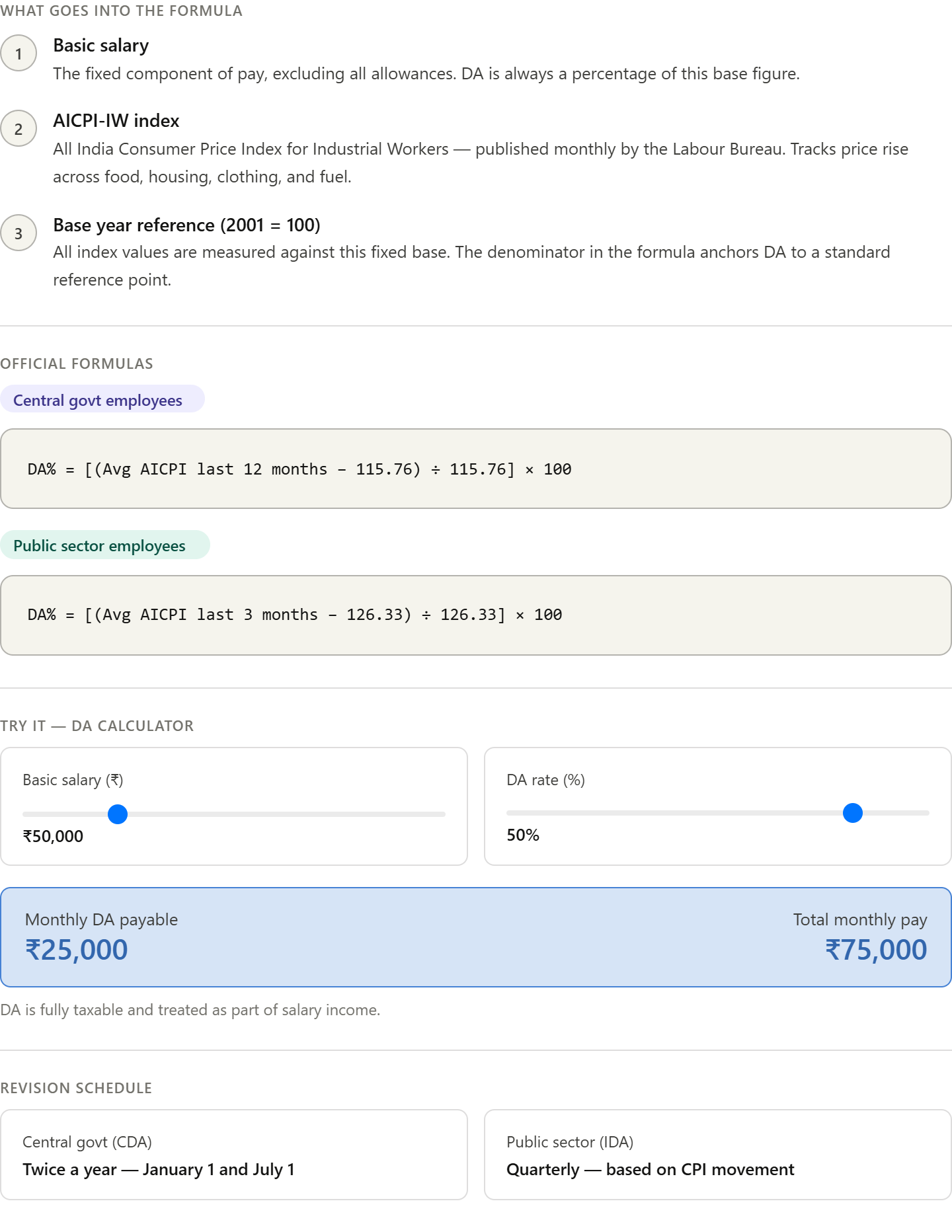
- It is calculated as a percentage of the basic salary or pension and is revised periodically — typically every six months — based on movements in the Consumer Price Index (CPI). Its core purpose is to offset the erosive effects of inflation on the real income of employees and pensioners.
Background and Nature:
- DA is given to employees in India, typically in the government sector, as well as some private sector companies, to help them cope with the rising cost of living due to inflation.
- It is intended to offset the impact of inflation on the purchasing power of employees' salaries and to ensure that their real income remains constant or does not decline.
- The dearness allowance is determined by the location of the employee since the impact of inflation differs — depending on whether a person works in the urban, semi-urban, or rural sector, their DA fluctuates.
- DA is distinct from the basic pay of an employee and is revised separately from salary adjustments.
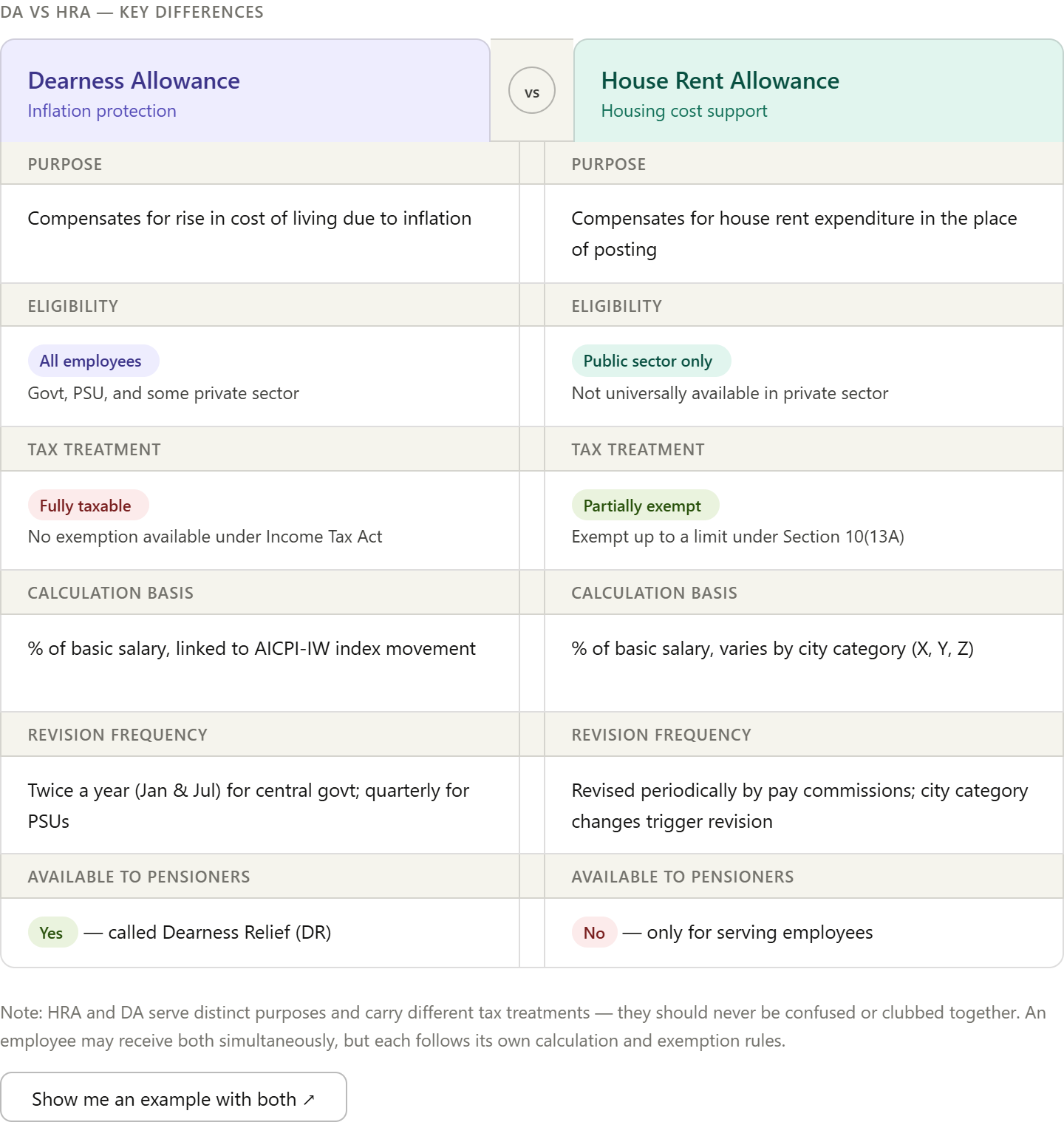
- DA is fully taxable under the Income Tax Act in India and is treated as part of salary income.
Calculation of DA:
Types of Dearness Allowance:
1. Industrial Dearness Allowance (IDA):
- Applies to employees working in public sector enterprises and government-owned corporations.
- The IDA for public sector employees undergoes quarterly revision depending on the Consumer Price Index to help offset the impact of rising levels of inflation.
2. Variable Dearness Allowance (VDA):
- Applies to employees in specific industries, particularly labour-intensive sectors under the central government.
- Dependent on three components: (i) Base Index — remains fixed for a particular period; (ii) Consumer Price Index — changes every month; (iii) Variable DA amount fixed by the Government, which remains fixed unless the government revises the basic minimum wages.
3. Central Dearness Allowance (CDA):
- Applies to central government employees.
- Revised periodically by the Central Government based on changes in CPI for Industrial Workers.
4. State Dearness Allowance (SDA):
- Applies to state government employees.
- Revised by respective state governments based on changes in CPI or other factors.
5. Dearness Relief (DR):
- Provided to pensioners to compensate for the impact of inflation on their pensions.
- Pensioners typically receive the same percentage of DA as current employees.
- Called Dearness Relief (DR) when provided to pensioners.
6. City Compensatory Allowance (CCA):
- Sometimes considered a type of DA.
- Provided to employees working in metropolitan cities or high-cost areas to offset the higher cost of living.
Impact on Pensioners:
- DA is also provided to pensioners — called Dearness Relief (DR) — to compensate for the impact of inflation on their pensions.
- Since DA compensates for the effect of inflation on one individual's cost of living, a person drawing multiple pensions is entitled to DA on only one pension at a time.
Significance:
- Protects government employees and pensioners from the erosive effects of inflation.
- Ensures that real income and purchasing power do not decline over time.
- Provides a structured, index-linked mechanism for periodic revision of compensation.
- Accounts for regional variation — urban, semi-urban, and rural employees may receive different DA rates based on local cost-of-living conditions.
DA vs. HRA: