


List of Current Affairs
Home / List of Current Affairs
Civil Law
Usufructuary Mortgage and Limitation Period
29-Dec-2025
|
"In usufructuary mortgages, the limitation period for redemption begins not from the date of mortgage creation but from the date of payment or tender of mortgage money." Justices B.V. Nagarathna and R. Mahadevan |
Source: Supreme Court
Why in News?
The bench of Justices B.V. Nagarathna and R. Mahadevan in the case of Dalip Singh (D) Through LRs. & Ors. v. Sawan Singh (D) Through LRs. & Ors. (2025) dismissed the appeal filed by mortgagees and affirmed that in usufructuary mortgages, the right to seek redemption arises from the date of payment of mortgage money, not from the date of mortgage creation.

What was the Background of Dalip Singh (D) Through LRs. & Ors. v. Sawan Singh (D) Through LRs. & Ors. (2025) Case?
- The appellants (original plaintiffs) were mortgagees of disputed property measuring 114 Kanals and 4 Marlas of land situated at Village Tamkot, Tehsil Mansa, District Bathinda.
- The property was mortgaged by the ancestors of the respondents (original defendants).
- The respondents/defendants filed an application under Section 6 of the Redemption of Mortgage Act, 1913 for redemption of the mortgaged property.
- The Collector allowed the redemption application vide order dated 17.09.1975 in favor of the respondents/defendants.
- Aggrieved by the Collector's order, the appellants/plaintiffs filed Civil Suit No. 291/1975 challenging the redemption order.
- The Trial Court decreed the suit in favor of the plaintiffs vide order dated 22.09.1976, holding that the application for redemption was barred by limitation and set aside the Collector's order.
- The respondents/defendants filed a first appeal before the Additional District Judge, Bathinda in Civil Appeal No. 107/R.T.-99 of 76/77, which was dismissed vide order dated 24.12.1980.
- The respondents/defendants then filed Regular Second Appeal No. 1053/1981 before the High Court of Punjab and Haryana.
- The High Court allowed the appeal vide order dated 18.09.2001, holding that the right to redeem the mortgage was not barred by limitation and that fresh cause of action accrued based on adjustments made to the loan from income arising from the land.
- The appellants/plaintiffs challenged this before the Supreme Court in Civil Appeal No. 6084/2002, which was allowed vide order dated 16.04.2009 on procedural grounds.
- The case was remanded to the High Court for re-adjudication as the High Court had failed to formulate substantial questions of law before allowing the appeal.
- After formulating substantial questions of law, the Punjab and Haryana High Court again allowed the appeal in favor of respondents/defendants vide order dated 25.01.2010.
- The High Court relied upon Ram Kishan and Ors. v. Sheo Ram and Ors. (2008) and restored the Collector's order dated 17.09.1975, dismissing the plaintiffs' suit.
What were the Court's Observations?
- The Supreme Court noted that the High Court had relied on Singh Ram (Dead) through legal representatives v. Sheo Ram and Others to allow the appeal filed by the defendants and dismiss the plaintiff's suit.
- The Court referred to the three-judge Bench judgment in Singh Ram Case (2014), which established the legal principle regarding limitation in usufructuary mortgages.
- The Court observed that in usufructuary mortgages, the period of limitation does not run from the date of creation of the mortgage but from the date of payment of mortgage money.
- The limitation period begins either from payment out of the usufruct, partly out of the usufruct, or partly on payment or deposit by the mortgagor as provided under Section 52 of the Transfer of Property Act, 1882.
- Until such payment or tender, the period of limitation would not start under Section 61(a) of the Schedule to the Limitation Act.
- The Court held that mere expiry of the prescribed period could not extinguish the mortgagor's right of redemption, and thereby the right of the mortgagee to seek declaration of title and ownership over the mortgage property remains untouched.
- The Court found force in the submissions of the respondents' counsel that applying the ratio of Singh Ram judgment would require dismissal of the plaintiffs' suit and restoration of the Collector's order.
- The Supreme Court dismissed the appeal filed by the plaintiffs, affirmed the High Court judgment, and dismissed the suit.
- The interim order of stay was vacated, and parties were directed to bear their respective costs.
What is Usufructuary Mortgage?
About:
- Mortgage is defined by Section 58 (a) of the Transfer of Property Act, 1882 (TPA) as a transfer of an interest in specific immoveable property for the purpose of securing the payment of money advanced or to be advanced by way of loan, an existing or future debt, or the performance of an engagement which may give rise to a pecuniary (monetary) liability.
- The transferor is called a mortgagor, the transferee a mortgagee; the principal money and interest of which payment is secured for the time being are called the mortgage-money, and the instrument (if any) by which the transfer is affected is called a mortgage-deed.
Types of Mortgages:
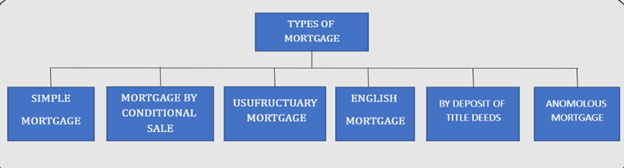
- Usufructuary Mortgage:
- Section 58(d) of TPA defines usufructuary mortgage.
- It states that where the mortgagor delivers possession or expressly or by implication binds himself to deliver possession of the mortgaged property to the mortgagee, and authorizes him to retain such possession until payment of the mortgage-money, and to receive the rents and profits accruing from the property or any part of such rents and profits and to appropriate the same in lieu of interest, or in payment of the mortgage-money, or partly in lieu of interest or partly in payment of the mortgage-money, the transaction is called an usufructuary mortgage and the mortgagee an usufructuary mortgagee.
- There cannot be two different usufructuary mortgages on the same property at the same time, as the possession can only be given to one only.
- In this type of mortgage, the mortgagee has the advantage to repay himself.
Constitutional Law
Denial of Permanency to HIV Positive Employee
29-Dec-2025
|
"Denial of benefit of permanency to the Petitioner on the ground of his status as HIV+ is clearly arbitrary, discriminatory and violative of Articles 14 and 16 of the Constitution of India." Justice Sandeep V. Marne |
Source: Bombay High Court
Why in News?
Justice Sandeep V. Marne of the Bombay High Court in the case of Kumar Dashrath Kamble v. Bombay Hospital (2025) held that denial of permanency to a workman solely on the ground of HIV-positive status is arbitrary, discriminatory and violative of Articles 14 and 16 of the Constitution of India, 1950(COI).

What was the Background of Kumar Dashrath Kamble v. Bombay Hospital (2025) Case?
- The petitioner was employed as a sweeper with Bombay Hospital since 1994.
- The petitioner's name was included in the list of temporary workmen eligible for permanency.
- During medical examination under the settlement, the petitioner was detected as HIV positive and declared medically unfit.
- The petitioner was denied permanency solely on the basis of HIV-positive status.
- Despite the denial, the petitioner continued to perform the same duties as colleagues who were made permanent.
- In 2017, after intervention by the Mumbai District AIDS Control Society, the petitioner was granted permanency prospectively.
- The petitioner approached the Industrial Court seeking declaration of permanency and consequential benefits from 2006.
- The Industrial Court dismissed the complaint, leading to the filing of the present writ petition.
What were the Court's Observations?
- The Court held that the Industrial Court adopted a hyper-technical approach in applying the principle of res judicata and failed to examine the real grievance of denial of permanency solely due to HIV status.
- The Court noted that merely because a Memorandum of Settlement dated 1 December 2006 had been arrived at, the petitioner was not precluded from raising the issue of denial of permanency.
- The Court observed that the petitioner's ailment never came in the way of discharge of his duties and that he had continued to work for nearly two decades after being detected HIV positive.
- The Court emphasized that when a workman continues to discharge the same duties as co-workers without any impediment, his HIV status cannot be used as a ground to deny permanency while extracting the same work for lower wages.
- The Court stated that such denial amounts to hostile discrimination and is contrary to constitutional values of equality and dignity.
- Referring to the HIV and AIDS (Prevention and Control) Act, 2017, the Court noted that discrimination against HIV-positive persons in matters of employment is expressly prohibited.
- On the issue of arrears, the Court held that the principle of delay and laches would apply, as the petitioner slept over his rights for over 12 years.
- The Court set aside the Industrial Court's order and directed Bombay Hospital to grant permanency to the petitioner with effect from 1 December 2006.
- Applying the principle of delay and laches, the Court restricted actual monetary benefits to a period commencing 90 days prior to the filing of the complaint.
- The Hospital was directed to pay all admissible arrears within three months, failing which interest at 8% per annum would be payable.
What is Human Immunodeficiency Virus (HIV)/AIDS?
About:
- HIV is a virus that attacks the immune system, primarily damaging CD4 cells (white blood cells), weakening the body and making it vulnerable to infections and cancers.
Transmission:
- Occurs via direct contact with infected bodily fluids (blood, semen, breast milk, vaginal fluids) like unprotected sex, shared needles, or unsterilized tattooing. It is not spread through casual contact.
Symptoms:
- Early signs include fever and rash. Later stages may involve swollen lymph nodes, weight loss, and diarrhea. Severe HIV can lead to opportunistic illnesses such as tuberculosis, meningitis, and cancers like lymphoma.
Treatment:
- There is no cure. However, lifelong daily Antiretroviral Therapy (ART) effectively controls the virus.
HIV and AIDS (Prevention and Control) Act, 2017:
- The HIV and AIDS (Prevention & Control) Act, 2017 is a central legislation protecting and promoting the rights of persons infected with and affected by HIV and AIDS.
- The Act came into force on September 10, 2018 with the objective to prevent and control the spread of HIV and AIDS and for reinforcing the legal and human rights of persons infected with and affected by HIV and AIDS.
- It also seeks to protect the rights of healthcare providers.
- The Act addresses stigma & discrimination and strives to create an enabling environment for enhancing access to services.
- It provides for diagnostic facilities related to ART and opportunistic infection management to people living with HIV and AIDS.
- The Act also provides for a robust grievance redressal mechanism in the form of Ombudsman at the State level and Complaints Officer at the establishment level aiming to provide speedy redressal.
What are Articles 14 & 16 of the COI?
Article 14 of the COI: Equality Before Law
- Two-Part Provision: Article 14 contains two distinct but complementary concepts.
- Equality before law (negative concept)
- Equal protection of the laws (positive concept)
- Equality Before Law: Prohibits discrimination and ensures no person is denied equal treatment before the law within Indian territory.
- Equal Protection of Laws: Requires the State to give special treatment to persons in different situations to establish equality among all.
- Core Principle: Equals must be treated equally, while unequals must be treated unequally to achieve true equality.
- Scope of Application: Extended to all persons, including:
- Citizens and foreigners
- Statutory corporations
- Companies
- Registered societies
- Any other type of legal person
Article 16 of the COI: Equality of Opportunity in Public Employment
- Primary Guarantee: Ensures equality of opportunity for all citizens in matters of employment or appointment to any public office.
- Prohibition of Discrimination: Prevents the State from discriminating on grounds of:
- Religion
- Race
- Caste
- Sex
- Descent
- Place of birth
- Residence
- Special Provisions Permitted: The State has autonomy to grant special provisions for:
- Backward classes
- Under-represented States
- Scheduled Castes (SC) and Scheduled Tribes (ST)
- Local candidates for certain posts
- Religious/Denominational Exceptions: Reservation of posts for people of a certain religion or denomination in religious or denominational institutions is not deemed illegal.
- Economically Weaker Sections (EWS) Reservation: Article 16(6), added by the 103rd Amendment in 2019, enables the State to provide up to 10% reservation in public employment (and education) for Economically Weaker Sections.